

--------------------------------------------------
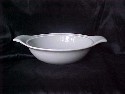
BAUER ART POTTERY(1945)
This line came in many different shapes and sizes; vases, ashtray, mantelpiece bowl, centerpiece bowl, square flower pot, tall flower
pot, centerpiece bowl with candleholder ends, long low bowl, oval vase, and bulb bowl. Usually the inside was one colored glaze while
the outside was another colored glaze. White and bronze is a common color combination. Black and coral are difficult glazes to find.
The Greens, Rust, Blues, and Cinnamon have not been found, but are listed as colors of glazes in the catalogues.
--------------------------------------------------
GLASSWARE
Bartlett Collins (1957) - These were glasses to be placed in discount stores and were priced so low that breakage was not a great loss.
Instead of replacing a glass, they were inexpensive enough that they could replace the set. Some of the designs included: Gay Nineties
scenes, cowboy motifs, and bottoms-up graphics. However, there are two designs that were quite successful; "Eclipse" and "Sunburst".
"Eclipse" was a polka dot motif with overlapping solid circles. "Sunburst" was a geometric pattern with rays of color in vertical
shoots. Both patterns came in Yellow, Turquoise, Green, and Flamingo Pink; all combined with gold. Ice buckets and other bar-related
items were also available in these patterns.
Duncan Miller Imperial Flair (Flare)(1959) - Believed to have been produced for about 5 years. It had a smooth inside and a granular
outside. Since it was textured to the touch on the outside, it was called "Seed". Colors found are pink and crystal. They were to be
made in Yellow, Blue, Smoke, Turquoise, and Amber Brown.
Imperial Pinch(1951) - It was designed to accompany "Iroquois Casual". There are three sizes of tumblers. It is named "Pinch" because
of the bottom depression. It was made in Seafoam, Verde, Smoke (a warm brown), and Canteloupe (a light amber), Chartreuse, Ruby, Pink,
and Crystal.
Imperial Twist (1949) - These are footed tumblers. Included ice teas, water tumblers, juice, and old fashioned glasses. They were found
in Smoke, Seafoam, Coral and Crystal.
Old Morgantown/Modern (1951) - This was a handmade glass. It included three sizes of tumblers, five stemmed items, a dessert dish, a
pilsner, chilling bowl and a double old fashioned. It was made in colors to complement the American Modern line. The colors included
Coral, Seafoam, Chartreuse, Smoke and Clear Crystal.
Snow Glass (1948-1953)- A crystaline glass with minute flakes of opaque white resembling snow flakes scattered randomly in the crystal-
line body. It was textured in feel and appearance. There were three sizes of tumblers, salad plates, saucers, fruit bowls, various lids,
a 2-pint pitcher, a round vegetable bowl, shakers, and candle holders. When identifying "Snow Glass", remember there are look-alikes.
One is designed by Paul A. Lobel and sold by Mary Ryan, an early Wright supporter. The line was called "Benduro" and was advertised as
an American Expression in Glass. It was made in several colors, but has been called "SnowFlake". There is a "Bubble Glass", which is
similar to "Snow Glass". It was designed and made by Irving Richards in 1942. It was made in Mexico and came in a 5 oz. juice glass and
a 10 oz. cocktail size. Also, a small amount of Fostoria Glass was produced. It may have been a prototype of "Snow Glass" and is now
part of a collection of The Huntington Museum in Huntington, West Virginia. It has a thinner body and is darker than "Snow Glass".
--------------------------------------------------
SPUN ALUMINUM - 1930's
One of the most successful of Wright's lines. It was divided into three categories; stove to tableware group, informal serving acces-
sory group, and an interior accessory group. Though the customers were told of the ease of keeping their items bright, they were easily
bent and dented. Because of that, items are hard to come by in good condition for collectors. Typical items were: ice buckets, casse-
roles with ceramic inserts, fruit bowls, lamps, ashtrays, canister sets, bun warmers, vases, etc. Up until the time of the war, sales
were doing quite well. But, the material for the items was no longer available for consumer use. After the war, the line never quite
recovered.
The mark for the spun aluminum pieces was signed with the Russel Wright name in block letters. A red inked stamp is sometimes found on
the wood and there were navy and white labels as well as string tags. The mark on the aluminum is sometimes hard to find and if a piece,
like a lid is missing where the mark might be, a collector may not ever know who the maker is.
--------------------------------------------------
PLASTIC - (1951)
Meladur was made in pink, mint green, yellow, and blue. Pieces made before the sale to General American are marked with Russel Wright's
signature. Pieces after are not marked. "Residential", was another line of Melmac by Russel Wright. Original colors were: Sea Mist,
Grey, and Lemon Ice, Black Velvet (black with aluminum dust) and Copper Penny (brown treated with copper dust). Later White, Light
Blue and Salmon (orange red) were added. Another line, "Flair" was patterned and was produced in 1959. It had several designs: Golden
Bouquet (puffs of white on golden stems), Spring Garden (blossoms of pink and blue on stems), Ming Lace (actual leaves of the Jade Orchid
Tree imported from China, cleaned, tinted, and permanently molded into the body), Woodland Rose (pink roses and green leaves on egg-
shell background), Arabesque(swirl pattern in two tones of gold or gold and turquoise on eggshell).
--------------------------------------------------
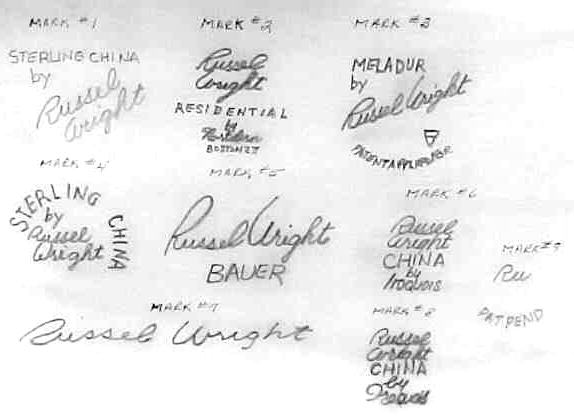
To view some of the many marks of Russel Wright items,
Click Here
Marks #1 & #4 - Usually found incised but is also found in raised relief. One of two marks Sterling used on the early line. Some
Sterling is not marked and some which is, the glaze filled the incised letters.
Marks #2 & #3 - One of several marks used for Russel Wright's synthetic dinnerware.
Mark #5 - Bauer items are marked, lightly incised with the signature filled in with heavy glaze. Vase bottoms can be heavily irregular.
Marks #6 & #8 - The two earliest marks for Iroquois, with #6 being the earliest and #8 next. They will be found in dark blue and brown.
Mark #7 - Found on early Century Metalcraft items.
Mark #9 - One of six Paden City/Justin Tharaud/Highlight marks.
For more information on Russel Wright:
Manitoga/The Russel Wright Design Center Click Here
Decorama And Here
REFERENCES:
Official Price Guide to Pottery and Porcelain - 8th Ed. - Harvey Duke
Garage Sale and Flea Market Annual - 3rd Ed.
Warman's Americana & Collectibles - 8th Ed.
Schroeder's Antiques Price Guide - 18th Ed.
Kovel's Antiques & Collectibles Price List 1991 - 23rd Ed.
The Collector's Encyclopedia of Russel Wright Designs - Ann Kerr
The Houston Chronicle - Feb. 8, 2002, 2:17PM "The power of Wright Midcentury designer's vision shapes modern
home front" By Renee Kientz


 |