
TM

Volume 5 Issue 1

CANDLES & CANDLEHOLDERS
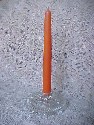
Candles date back as far back as the middle ages. They, obviously, were a necessity then as a means of light. They lost their importance for lighting in the early 20th century. They were then only
used in churches or for emergency lighting.
During the 16th century, candles were found in the homes of the middle class. They were usually sold by the pound in bundles of eight, ten, or twelve. The early Chinese and Japanese made candles
with wax from insects and seeds. Wax skimmed from boiling cinnamon was used to make tapers for temple use in India. The first known candle in America is attributed to the Native Americans. They
burned oily fish, called candlefish, wedged into a forked stick. The early settlers of New England used wax from Bayberries. Tallow was another common candle making material. Although, beeswax
was preferred over tallow due to its odor. In the 1800's paraffin made tallow obsolete, and it is rarely used in candles anymore.
During the mid-17th century the custom of adding small candles to the Christmas tree began. It was first widely used in Germany then spread to Eastern Europe. Candles were glued onto the tree with
melted wax or attached with pins. Later, approximately 1890, small candleholders were used for the Christmas candles. Between 1902 and 1914, small lanterns and glass balls were used to attach the
candles to the Christmas tree. Then, in 1882, the first Christmas tree was lit by electricity.
There was a resurgence for the use of candles in the 1960's for mood lighting or for special occasions. A type candle that became popular in the 1980's is the tea light. The holders for the tea lights
were made of brass, ceramic, or glass.
There are several styles of candleholders. The earliest type was the picket type, which has a sharp point to hold the candle and sometimes can be found today. The socket type, which is used more often
today, began to come into use in the mid 1660's. Some other types are the thin candleholders for tapers, holders for the pillar type candles, and those for tea lights.
Candleholders are made from various materials. Metal is the classic material. It can be easily molded into any form and are much more sturdy. After many years of polishing, a patina forms.
Glass candleholders can be found in many colors. The most popular are blue, clear, and green. Although, pink is becoming popular and can be found occasionally in depression glassware.
Ceramic candleholders can be plain fired clay or simple colored ones. The style is usually the basic simple form as it best resists the firing process. Clay candle holders have been found in Egypt, which
are dated from the 4th century B.C.
Wood candleholders can be carved, painted, stained, or turned into various shapes. They tend to have a heavier, masculine look to them. They were initially used in castles and cathedrals.
Candleholders usually followed the style of furniture. So, when attempting to date a candleholder, remember to determine the style used in the manufacture of the candleholder.
REFERENCES:
Candles & More
The Ram's Horn Studio
About.com
Schroeder's Antique Price Guide - 18th Edition
Garage Sale & Flea Market Annual - Third Edition
**************************************************************
Questions? Email Us!

SIGN UP HERE!
Mailing
List!