


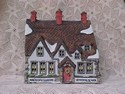
There are many types of Christmas collectibles. Christmas cards, postcards, ornaments, decorations, figurines, music boxes, and candleholders are just a few.

Christmas cards can be found in many designs. They began as school projects in England  for children to show their handwriting progress and as a greeting to
their parents.

In 1843, J. C. Horsley was the designer of the first Christmas card. It was a scene framed in three panels of a homey table scene and two sides, each depicting
charity scenes of feeding the hungry and clothing the naked. It was lithographed on a stiff, dark cardboard with the words "A Merry Christmas and a Happy
New Year to You."  One thousand were printed with one still surviving today.

During that time postage was one penny, hence the custom of sending Christmas cards began. Today, Americans send more than 2 billion cards each year.

Christmas postcards have a large following and the selection is quite large. The most collected of postcards is Santa Claus. It is divided into two groups; Santas
in red suits and Santas in other colors. The Santas in other than red suits are the most sought after among the Santa in suits postcards. The most valuable of
Santa Claus postcards are the Santas with a black face, the hold-to-light, and installment. The rarest of Santa cards is the hold-to-light Santa dressed as Uncle
Sam. Installment cards are postcards broken into segments and mailed individually to make up a single picture once they are all received and put together. They
were very popular here and abroad and were made in the early 1900's. Hold-to-light postcards are cards that can be held to the light which results in seeing a
different image or an additional image. One of the most common is Santa coming down the chimney. They were produced in the early 1900's, as well.

Christmas decorations and ornaments date back to the mid-1800's. The Pennsylvania Dutch brought the first glass ornaments to America in 1865. The early Santa
ornaments are the most prized by collectors, especially those in robes of fur or mohair or those dressed in unusual colors.

Christmas lights for Christmas trees were first manufactured to be marketed in 1903. They were very expensive and were considered a safety hazard. In 1921 safety
regulations were put into force and were guaranteed to be safety approved. The first bulbs were replicas of Edison's household light bulb. Later, G.E. produced
bulbs that were rounded with a point at the end.  Until 1919 all bulbs were hand-blown. Around 1910, Austria produced the first figural bulb, with Japan not far
behind.  Japan's were not of the same high quality as the Austrian bulbs, however. The first machine-made figural bulbs were made by American manufacturers. The
figural bulbs are today highly collectible. From 1945-1960, the bubble lights were very popular. Once the miniature lights were produced, enthusiasm for the bubble
lights waned and the manufacturers discontinued making replacements.

Christmas collectibles do not necessarily have to be old to be collectible or have a value. Some of the modern Christmas collectibles are Hallmark Keepsake ornaments,
American Greetings, Department 56 buildings and accessories, Lefton Colonial Village Buildings and accessories, Enesco ornaments, and Christopher Radko. Prices can
range from $5.00 to several hundred dollars.

To view some of the above mentioned Christmas Collectibles  Christmas Collectibles

RESOURCES

Garage Sale & Flea Market Annual - Third Edition
Encyclopedia of Antique Postcards by Susan Brown Nicholson
Schroeder's Antiques Price Guide - Eighteenth Edition, 2000
Warman's Antiques and Collectibles Price Guide - 32nd Edition
Warman's Americana & Collectibles - 8th Edition

 |
