


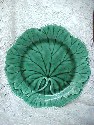
Next Month's Newsletter will feature Fire King Glassware.The beginnings of majolica can be traced as far back as the 9th century in Baghdad. In the 11th century Islamic pottery was used for the embellishment of religious and civic buildings. During the 13th to the 15th century, pieces of Hispano-Moresque pottery were transported from Spain to Italy. The Spanish shipping port, Majorca, is what the pottery was named after. Majolica is a tin-oxide-glazed, painted earthenware. The clay piece is molded or thrown, then given a "bisque" firing. It is then covered with opaque lead and tin-oxide glaze. Decorations on the piece are then painted and a second firing which causes the glaze and decoration to meld to cause a glossy finish. There have been many makers in England and Stoke-on-Trent. Some of the better known makers that date from the 18th century are John Astbury, Thomas Whieldon, Josiah Wedgwood, Ralph Wood, and Thomas Minton. Later, in 1879, American potters took interest in majolica. One of the first makers of American-made majolica was Griffen, Smith, and Hill. The most highly collected English pieces were produced by Minton, Wedgwood, Royal Worcester, Holdcroft, Lear, and George Jones. American makers were Eureka and Chesapeake Potteries and Griffin, Smith, and Hill. In continental Europe the best known are Sarreguemines, Luneville, and Villeroy and Boch. Herbert Minton with a French ceramic chemist, Leon Arnoux presented majolica at the Great Exhibition at the Crystal Palace in London. Minton artists developed styles from the Renaissance, Palissy design, Gothic revival and medieval styles. Figural pieces of human and mythological figures were produced. Some were shaped into cache pots, urns, fountains, umbrella stands, and large birds and animals for the garden. The dinner table was also a place you could find majolica. Oyster, crabs and lobster plates and fish platters were found. Water, milk, and cream pitchers were found in naturalistic designs, as well as containers which were designed showing what was within the container. Wedgwood was about 10 years behind Minton. The Wedgwood glaze was more dense than Minton and more formal. In 1878, Wedgwood produced Argenta ware. Argenta ware has white backgrounds surrounding the Wedgwood pattern. Most frequently seen are salad plates in green with raised leaf designs. The principal colors of majolica are green, blue, purple, and brown, yellow, orange, and white. At the American Centennial in Philadelphia in 1876, majolica was recognized as an important type of pottery. Griffen, Smith, and Hill began to manufacture a dinnerware service named "Shell and Seaweed". It was first made to imitate the Wedgwood Argenta ware, but was not accepted by the public. Therefore, it was then made in nacreous shell pink, which was well received. They also made various pieces of syrup jugs, sardine dishes, pitchers, plates, and tea services decorated with birds and various flowers. Due to the effects of lead poisoning and labor disputes, majolica production came to an end in 1901. Some majolica was still produced in Europe, however, which produced the link from majolica to Art Nouveau. REPRODUCTIONS Some collectors, to increase their collections, have turned to reproductions due to the high cost of Victorian majolica. It would be wise, however, to distinguish the difference between the original from the reproduction. In reproductions, the glaze is less intense and less uniform. The weight can be also less. Victorian majolica is almost always glazed on the underside and the rims. There may not be any on repros.
Some reproductions are valid. Minton's copy is to celebrate the Minton bicentennial. Since 1993, Minton has reproduced almost exact copies of its Victorian majolica teapots. They include: Monkey tea pot, The Chinese Actor tea pot, the Cat and Mouse tea pot, the Monkey and Cockerel tea pot, the Blowfish tea pot, and the Turtle tea pot. These are all marked accordingly. To view the process of making majolica: The Making of Majolica EXAMPLES To view some examples of Majolica: Majolica REFERENCES: Collectics.com Mary's Maiolica Arts Majolica International Society Schroeder's Antiques Price Guide - Eighteenth Edition Garage Sale & Flea Market Annual - Third Edition

 |
